
Stop Demanding 100% WCAG Compliance — You’re Making Accessibility Worse

Jeff Rodgers
May 23 10 min read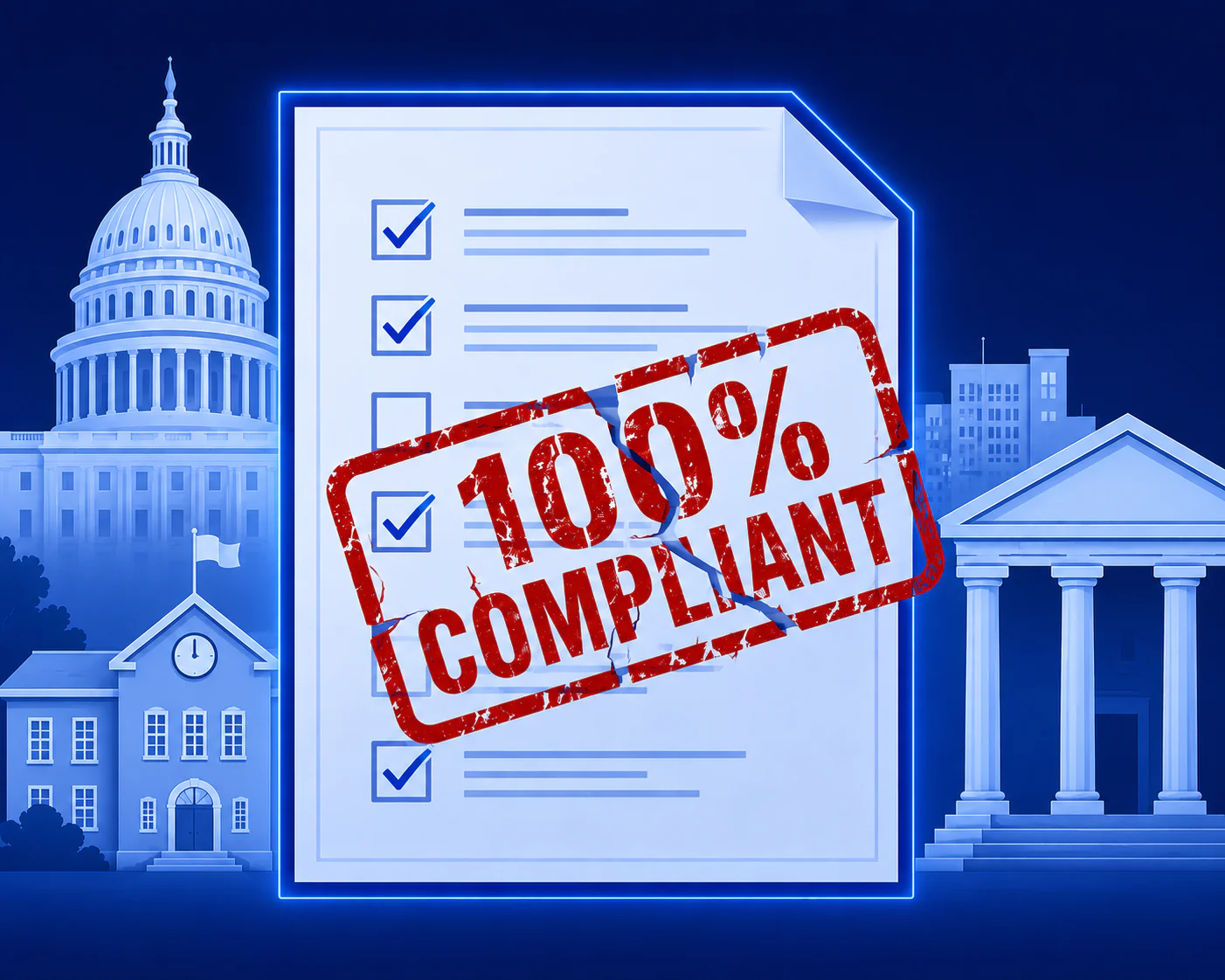
If you work in leadership, procurement, or compliance for a state agency, county government, school district, or any other entity covered by Title II of the ADA, this one is for you.
I want to talk about something that is creating serious problems across the digital accessibility space — and it starts with a phrase that sounds reasonable on its face: “We require 100% WCAG compliance.”
I get it. You’re under pressure. The DOJ’s updated ADA Title II Rule has put digital accessibility on the radar of every covered entity in the country, legal teams are nervous, and nobody wants to end up in a complaint or a lawsuit. So when your agency goes out to procure a digital product — a student information system, a constituent portal, a learning management system — you ask vendors to prove their product is fully accessible. You want a clean VPAT. A perfect score. Full conformance.
The intention is good. The requirement is creating a mess.
What WCAG Actually Is (And What It Isn’t)
The Web Content Accessibility Guidelines (WCAG) are published by the World Wide Web Consortium (W3C) and represent the international standard for digital accessibility. WCAG 2.1 Level AA is what the DOJ’s Title II Rule points to as the benchmark for covered entities.
Here’s what a lot of people in procurement and compliance don’t know:
WCAG is not a universal checklist that every product must pass in its entirety to be considered accessible!
The guidelines are organized into success criteria that address specific types of content, functionality, and platform features. Some criteria apply to video. Some apply to forms. Some apply to real-time communication. Some apply to motion and animation.
A product that has no video doesn’t need to conform to the success criteria about captions. A platform without a time limit doesn’t need to address the criteria around timing adjustments. The criteria exist to cover the full range of what a digital product might do — not to serve as a required to-do list that every product must complete in full, regardless of what the product actually does.
Demanding 100% WCAG conformance across all success criteria from every vendor reveals a fundamental misunderstanding of how WCAG works. This misunderstanding is causing real harm. When your procurement requirements are built on a false premise, everything downstream from that — your vendor evaluations, your purchasing decisions, your compliance strategy — is built on a shaky foundation.
You can’t get the right answer if you’re asking the wrong question.
The VPAT Is a Disclosure Document, Not a Report Card
Let’s talk about VPAT/ACR requirements for a minute, because this is where a lot of covered entities get into trouble.
A VPAT — Voluntary Product Accessibility Template — is the document vendors use to produce an Accessibility Conformance Report (ACR). The purpose of the ACR is to disclose how a product currently conforms to each applicable WCAG success criterion. It is a transparency document. The operative word there is “disclose.”
A well-completed ACR will show “Supports” for criteria the product actually meets 100% of the time, “Partially Supports” where there are gaps, and “Does Not Support” where the product fails to meet a criterion. It will include explanatory remarks. It paints an honest picture of where a product stands.
When your agency demands a “clean” VPAT — meaning everything must say “Supports” — you are not asking for an honest assessment. You are asking vendors to tell you what you want to hear. And most of them are more than happy to comply!
We see this week in, and week out. Clients putting the pressure on us to “pass” a criterion because they have a sale they don’t want to loose. A state or county that is demanding 100% conformance.
This is the part that should keep your legal team up at night.
If a vendor marks a criterion as “Supports” when it actually does not, they have compromised the integrity of the entire report.
If they misrepresented one criterion, what else did they misrepresent? And when your agency selects that vendor based on a falsified ACR, your agency is the one that made the procurement decision. Your agency is the one legally responsible for ensuring the digital products and services you offer to the public, your students, or your constituents are accessible.
A dishonest VPAT doesn’t protect you!
It sets a trap for you. And you walked right into it by demanding a document that was never designed to function as a compliance guarantee in the first place. If your agency gets hit with an accessibility complaint after relying on a falsified ACR, “the vendor gave us a clean VPAT” is not going to be a satisfying answer for the people who couldn’t access your services.
Demanding Perfection Invites Dishonesty
We work directly with ed-tech companies, software developers, and digital product vendors every day. A huge number of them are under enormous sales pressure to produce spotless VPATs. I’ve seen it firsthand — vendor teams pushing hard to have accessibility testers mark criteria as “Supported” simply because they cannot afford to lose a government or education contract.
And you know what drives that pressure? Agencies and covered entities that require perfect scores as a condition of procurement.
What you’re doing, whether you realize it or not, is incentivizing dishonesty.
When a vendor believes that an honest ACR showing a handful of “Partially Supports” ratings will cost them the deal, they have to make a choice between integrity and revenue. Some will choose integrity. Most won’t. And since most procurement teams don’t have the expertise to audit VPAT/ACRs for accuracy, falsified ones often get through.
Demanding unrealistic standards in accessible procurement doesn’t raise the bar. It just teaches vendors to get better at faking it.
If your team can’t tell the difference between an honest ACR and a fabricated one — and most procurement teams can’t without training — then you are essentially outsourcing your legal exposure to whoever is most willing to tell you what you want to hear.
I hope that scares the bajeezus out of you, because it should!
What ADA Title II Compliance Actually Requires
The DOJ’s updated ADA Title II Rule, which extended the compliance deadline for smaller covered entities (those with populations under 50,000) to April 2027, does not require perfection. It requires covered entities to make their digital content and services accessible to people with disabilities, using WCAG 2.1 Level AA as the technical standard.
Compliance is a process. It requires planning, evaluation, remediation over time, and ongoing monitoring. The DOJ’s own guidance acknowledges that entities will be at different stages of that process. What the rule demands is good-faith effort, documented progress, and a real commitment to access.
Nowhere in the DOJ rule does it say that every product you procure must have a perfect VPAT on the day you sign the contract.
What it does say, implicitly, is that your agency is responsible for the accessibility of what you deploy.
That means your job in procurement is not to find a vendor who can hand you a document with all green checkmarks. It is to find a vendor whose product works for your users with disabilities, who can demonstrate a credible commitment to accessibility, who is transparent about where their gaps are, and who has a plan to address them.
That is a very different conversation than “show me a clean VPAT.” And if your agency hasn’t made that shift yet, you are spending time, energy, and vendor goodwill chasing a standard that doesn’t exist in the regulation you’re trying to comply with. Read the rule. It does not say what your procurement team thinks it says.
How to Actually Evaluate a Product for Accessibility
If your team’s current process is to request a VPAT and then scan it for anything that isn’t “Supports,” you are not doing accessible procurement. You’re doing paperwork theater. Here’s a better approach.
Start by understanding what your users actually need.
Who will be using this product? What assistive technologies are they likely to use — screen readers like JAWS or NVDA, voice control software, keyboard-only navigation? What types of tasks will they need to complete? That context should drive your evaluation criteria.
Then, read the ACR with some level of informed scrutiny.
You don’t need to be a WCAG expert to spot red flags. If a product that includes video content shows “Not Applicable” for caption-related criteria, that’s a problem worth questioning. If a product with complex forms shows “Supports” across the board but has zero explanatory remarks, that’s worth a follow-up. A well-completed ACR includes notes. Silence is not confidence — it’s often a warning sign.
Ask vendors to demonstrate accessibility, not just document it.
Request a live walkthrough using a screen reader. Ask them to show you how keyboard navigation works through their core user flows. Ask what their remediation process is when new accessibility issues are identified. Vendors who take accessibility seriously can answer those questions. Vendors who are faking it usually can’t.
Look for ongoing commitment, not one-time certification.
A product that was tested two years ago and has since had three major feature releases is not the same product that was tested. Ask how often accessibility is evaluated, how issues are tracked, and what the typical turnaround is for remediation.
Finally, build your own internal knowledge.
You don’t need to become a WCAG expert. But you do need enough literacy to have an informed conversation with vendors and to evaluate what they’re telling you. There are free resources — WebAIM, the W3C’s own documentation — that can give you a solid foundation. Heck, read some more of our blogs! You can always bring in an accessibility consultant to help you build an evaluation rubric and train your procurement team.
The Real Risk of Getting This Wrong
Let’s be direct about what’s really at stake.
Covered entities under ADA Title II have a legal obligation to ensure that the digital services they provide are accessible to people with disabilities.
That obligation doesn’t transfer to the vendor when you sign a contract. It stays with you.
If your agency deploys a student portal that a blind student can’t navigate, or a county services website that someone using voice control can’t operate, the complaint is going to land on your desk — not the vendor’s. The VPAT you collected during procurement may look clean, but if the product doesn’t actually work, that document won’t save you.
The expectation of perfect WCAG conformance across all success criteria from every vendor isn’t protecting your agency. It’s creating a procurement environment where honest vendors are penalized for transparency and dishonest ones are rewarded for telling you what you want to hear. That’s not a compliance strategy. That’s a liability waiting to happen.
A Better Standard for Covered Entities
The goal of ADA Title II compliance in digital accessibility is not to collect perfect documentation. It is to ensure that people with disabilities have equal access to your services, your information, your platforms, and your programs.
That requires real evaluation, not checkbox procurement. It requires asking harder questions and being willing to accept honest answers. It requires understanding that a vendor who shows you an ACR with a few “Partially Supports” ratings and a clear remediation roadmap is probably a more trustworthy partner than one who hands you a spotless document with no supporting detail.
Start building an accessible procurement process that reflects what you actually need: products that work for your users, vendors who are transparent about where they stand, and a clear path toward continuous improvement. That’s what ADA Title II compliance looks like in practice.
If your team needs help building an accessible procurement rubric, evaluating ACR/VPAT documents, or understanding what realistic WCAG conformance expectations should look like for the products you buy — that’s exactly the kind of work we do at Accessiblü. We can help you ask better questions before you sign, not scramble for answers after.
-
 May 21 12 min read
Stop Guessing! How to Answer ADA Title II Compliance Requests
-
October 15 7 min read
Digital Accessibility and Scalability Costs
-
October 09 5 min read
2022, Midterm Election Campaign Websites – Not Accessible for Disabled
-
February 17 5 min read
Accessibility Strategies for the New Year
-
September 17 6 min read
ADA > CCPA: Why You Should Spend at Least As



Contact Accessiblü
Let's talk - ASAP!
To speak with an accessibility professional, fill out this form, and we will get back to you - typically within hours.
* Required