

Why we do this
Accessibility should be achievable, affordable, and something you can actualize.
-
01
Achievable
Every standard we test against has a finite, knowable list of requirements. Accessibility is a skill, not a mystery — and a team that is shown what to do can do it.
-
02
Affordable
Accessibility gets expensive when it is bolted on late, bought as a subscription nobody reads, or handed wholesale to someone else. Scoped properly and caught early, it costs a fraction of any of those.
-
03
Actualize
A report you cannot act on is not progress. Everything we hand over names the criterion, shows the failure, and says what to change, so the work actually gets done.
-
04
The Web is for Everyone
We believe the web should be accessible to everyone, by default.
-
05
It Takes Expertise
Conformance with the recognized standards takes more than automation. It takes people who use assistive technology every working day.
-
06
We Can Help
Accessibility lawsuits continue to rise, and we can help lower that risk while making your digital assets genuinely usable. The lowered risk is a side effect, though — not the reason to do it.
About Accessiblü
Our Story
Accessiblü began in 2020 as the internal accessibility division of New Possibilities Group, founded by Pete Czech. Pete saw early what most agencies were missing: accessibility was not a line item on a web project, it was a discipline of its own, and it needed people who did nothing else.
That call was right. In 2022 the practice split out and became Accessiblü, its own company with its own clients.
Jeff Rodgers joined in 2021 as Manager of Digital Accessibility, became Director of Digital Accessibility in 2024, and took over the company in 2026. We now operate as Accessiblü Solutions.
This new chapter is a narrowing rather than a pivot. We are concentrating on the work we have always been strongest at: consulting for public agencies meeting their obligations under ADA Title II, expert testing and auditing for Title III businesses, and helping organizations hold that standard afterward through monitoring, training, and compliance planning.
About Accessiblü
Who We Are
The Accessiblü team is a diverse group of professionals passionate about ensuring everyone can access digital information. Our backgrounds and skillsets are as diverse as the people who work here.
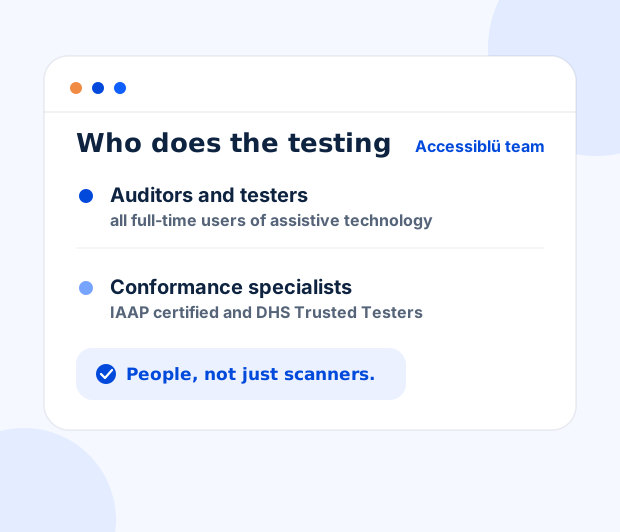
What sets us apart is who does the testing, and how precisely we explain what has to change. We offer aesthetically accessible solutions that respect the integrity of your designs. Alongside our conformance specialists, we have experts in learning design, instructional design, and human resources.
Our conformance and auditing team includes disabled veterans and daily users of assistive technology. Our goal isn’t just to conform to a set of accessibility standards. We go beyond to ensure your website, app, or document is usable and offers a positive, inclusive experience.
Most of our work sits in two places: expert testing and auditing for public agencies meeting their obligations under ADA Title II, and the same work for Title III businesses that need to know where they actually stand. Meet the people who do it.
 Accessiblü is an organizational member of the International Association of Accessibility Professionals.

Experienced
Accessibility specialists, not generalists. Our testers and auditors work with assistive technology daily, not occasionally.

Focused on Fairness
We believe access is an obligation, not a legal threat to be managed. We help organizations meet it, including when a demand letter is what started the conversation.

Value Brokers
Accessibility is a skill set, but it doesn’t make sense to make a full time hire in many cases. Our team augments your team to provide this skill as required.

We want to build a more accessible web, one site at a time.
Accessiblü Motto
We’ve built a practice around experienced human analysis — testers who use the same assistive technology your visitors do. That is how conformance gets reached and held: not by a scan, but by a person who can tell you exactly what has to change and why. It lowers your legal exposure, and it is the right thing to do.
-
A report you cannot act on is not progress.
Identify, educate, guide. In that order.
Most vendors sell a scan or a subscription. We start by finding what is genuinely broken — with a person driving the same assistive technology your visitors use — and then teach the people who build and publish your content to recognize it themselves. That is what makes the improvement hold after we leave.
-
We guide remediation. We do not take over your codebase.
Your developers make the changes; our job is to make sure they know exactly what to change, which success criterion it fails, and why it matters to a real person. The exception is documents — PDF, Word, Excel and PowerPoint remediation is work we do ourselves.
Your codebase stays yours.
What that looks like in practice
Audit, testing, training and consulting — with monitoring available inside a Managed Accessibility Ops engagement rather than as a product of its own. You can see how each is scoped and priced on our accessibility services page.
-

Testing
Testing is the centerpiece of accessibility conformance. It is how you find out where your digital property actually stands against the recognized standards — we test to WCAG 2.2 Level AA, which includes everything WCAG 2.1 requires.
In our practice, testing is not only automated. Only a person can understand context. Only a person can recognize how usable your website or application really is to someone who depends on assistive technology. What you get is a holistic assessment written from the perspective of actual users, so the work that follows improves the experience rather than only clearing a checklist. See what a full accessibility audit covers.
-
Remediate
To reach conformance you have to fix what testing found. Remediation takes time, and in-house teams are often unsure what they are fixing or why it matters.
We do not touch your codebase. Your developers make the changes; our job is to make sure they know exactly what to change. We give detailed evidence of every issue, cite the success criterion it fails, and recommend a fix. Documents are the exception — PDF and Office document remediation is work we do ourselves.
-
Educate
Accessibility is not a one-off project. A site that tests and conforms one day can be non-conforming the next if content editors, developers or other team members publish content or code that is not conforming. Our job is not just to test and advise on remediation, but also to educate.
We do that through what we publish, and through training and one-on-one consulting. Accessibility is more than a technical adaptation — it is a cultural shift in your organization, and we will help you make it with workshops, training, or whatever format suits your team.
-
Monitor
Accessibility does not hold still. A site that conforms today can regress the moment an editor publishes a new page or a developer ships new code, so the last part of the work is watching for that.
Monitoring is an add-on, offered inside a Managed Accessibility Ops or litigation-response engagement rather than as a standalone product. Automated scanning surfaces candidate faults, a person verifies them, and anything real is escalated for repair. It does not replace testing — it tells you when it is time to test again.


Contact Accessiblü
Let's talk - ASAP!
To speak with an accessibility professional, fill out this form, and we will get back to you - typically within hours.
"*" indicates required fields