Description
If the DOJ reviewed your agency’s digital accessibility today, what level of compliance would they give you? Compliance is ultimately judged by a court, not a checklist. What protects your agency is a dated, documented process your team actually followed — and that’s what this Handbook builds, starting the week you open it.
A full ADA Title II consulting engagement typically runs $10,000–$15,000+. This gives your team the same phase-by-phase framework — built from real municipal engagements — for $397. At that price, most agencies clear it under a standard discretionary-purchase limit; check your agency’s threshold, but an RFP usually isn’t required.
“Why not just use ADA.gov and AI?”
ADA.gov tells you what the law requires. It doesn’t give you a workflow, an owner for each task, or a sequence to follow. Generic AI doesn’t know DOJ’s specific exemption standards for legacy content — and if it drafts something your city attorney has to reject, you’ve lost more time than you saved. This Handbook is the workflow layer free resources don’t provide.
“Accessiblü was the first vendor we interviewed that helped us feel less panic and more purpose as our county approached our work in Accessibility and meeting the WCAG guidelines. The guidance we received from Jeff was practical, helpful, and focused on how we can make the DOJ ruling work within our limited staff and funding situation. Accessiblü’s model of scaling to the scope that is needed, rather than a one-size-fits-all model, was perfect for our team and has provided us with the tools we need on our path towards compliance.”
Written by Jeffrey Rodgers, MS Ed, Owner & Accessibility Consultant, Accessiblü Solutions, LLC.
If you work for a county, city, school district, or any public entity covered by the DOJ’s ADA Title II rule, this is the plan for getting compliant and staying there. It is built from years of engagements with agencies of every size and budget — not theory from a textbook. You do not need an accessibility background to use it. It is written for the people who actually carry the responsibility: administrators, IT directors, compliance officers, communications staff, and the counsel advising them.
Twelve phases, most of which take less than an afternoon
This isn’t a book to read cover-to-cover before you can start. Each phase is a self-contained unit of work with its own owner, checkpoint, and deliverable — many agencies clear two or three phases in a single sitting. Compress it into a sprint or spread it across a year; the sequence works either way. 101 pages, organized as a twelve-phase sequence you can compress or extend to fit your agency.
- Foundation — governance, ownership, and what the rule actually requires of you
- Digital Inventory — finding every site, app, document, and third-party platform in scope
- Baseline Accessibility Audit — establishing where you genuinely stand
- Prioritization and Remediation Planning — sequencing the work by risk and reach
- Website Remediation — fixing what you control
- Document Accessibility — PDFs, forms, and the backlog question every agency faces
- Third-Party Platforms and Vendors — the systems you bought and cannot directly fix
- Staff Training — building capability so accessibility does not regress
- Testing and Quality Assurance — verifying fixes actually worked
- Policy and Public Commitment — the policies and statement that make it institutional
- Verification and Documentation — evidence that stands up to scrutiny
- Ongoing Compliance Operations — keeping it true after the deadline passes
What every phase gives you
- Action items assigned by owner role, so the work is delegable rather than a reading list
- A phase checkpoint — what must be true before you move on
- Named deliverables and effort estimates, so you can plan and budget the phase
- The mistakes that trip agencies up, drawn from engagements where they happened
Also covered
- WCAG 2.1 AA — the legal requirement — alongside WCAG 2.2 AA as current best practice
- Procurement and vendor guidance, including how to read an accessibility conformance report critically
- Undue burden: when it genuinely applies, and how to document a determination
Three formats, one purchase
- Interactive web edition — navigate by phase in a browser, no install
- PDF — for printing, circulating, and attaching to a board or council packet
- Editable Word document — adapt the language to your agency
First edition, 2026. Includes all future updates to the Handbook.
Common questions
Does this guarantee we won’t get sued or cited by the DOJ?
No product can promise legal immunity — compliance is ultimately evaluated by courts and regulatory bodies. What this Handbook gives you is a documented, dated process that demonstrates good-faith effort starting today. If a complaint or inquiry comes in, an established process is your strongest line of defense.
We don’t have the staff or time for a 12-phase program right now.
You’re not committing to a year-long project on top of your existing workload. Each phase is scoped to be delegable — many are cleared in a single sitting using the role-based action items and checkpoints already built for you.
Why pay $397 when ADA.gov has free guidance?
ADA.gov tells you the legal standard. It doesn’t tell you who on your team does what, in what order, or what “done” looks like for each step — which is where agencies actually get stuck. This is that missing layer, built from real municipal work.
Do I need to take this through an RFP or council approval?
At $397, this typically falls under standard discretionary-purchase authority — confirm your agency’s threshold, but most buyers don’t need to run a formal procurement process for it.
Should I get the Toolkit too?
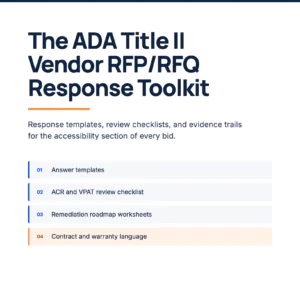
The Handbook tells you what each phase requires. The Toolkit is the set of templates and forms you actually fill in when you get there. Bought together as the bundle, it’s $597 — a $97 savings over buying separately.